




BREAST AUGMENTATION
 Safe Techniques, High-Quality Medical Materials
Breast augmentation
It concerns the aesthetic restoration of the volume of a woman's most important symbol of sensuality, the breast. Its aim is to correct volume and restore asymmetries (anisomastia). In rare cases, breast augmentation techniques can also be used to correct congenital chest abnormalities (Poland syndrome).
Various materials have been used over time to restore volume, the most prevalent being silicone in the form of cohesive gel. The properties of this particular biomaterial have been tested over time in numerous studies and have allowed us to speak of safety in use and the absence of risk of developing neoplasms.
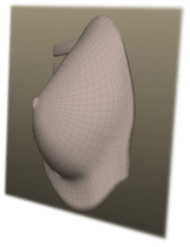 Choosing the right material is proof of the combination of in-depth knowledge and technical training of the plastic surgeon. This is because each female body has particular characteristics and chest morphology, which in each case call for the use of a specific method or a combination of methods.
Silicone implants can be classified according to their surface as smooth or textured, according to their material as soft silicone or cohesive silicone, according to their profile as high, moderate or low profile, and according to their shape as round or anatomical (teardrop-shaped).
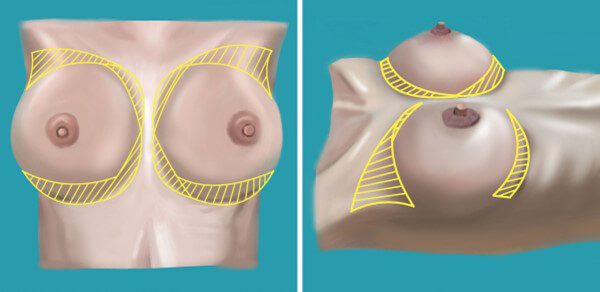 A general principle for every patient is the thorough measurement of the dimensions of the chest, as well as of the thickness of the skin envelope, i.e. the skin that will receive the implant. The latter is considered essential for achieving a natural result. When the skin envelope is thin and the chest is not covered by enough subcutaneous fat, breast augmentation becomes particularly demanding, since the use of anatomical implants and their placement as deep as possible in the chest is indicated. In these cases, their classic placement behind the mammary gland is not followed, because the coverage it offers is considered insufficient for the edges of the implant. Thus placement under the pectoralis major muscle or its fascia, or even the dual plane technique, is preferred. The approach, and consequently the incision, can be periareolar, in the inframammary fold or in the armpit. The inframammary approach is generally preferred, because it achieves the most satisfactory aesthetic result without interfering with the function of the mammary gland (breastfeeding).
An important part of every preoperative assessment is a mammogram and/or breast ultrasound. This examination protects the patient against the existence of any undiagnosed breast conditions, and also provides suitable images for later comparative study.
Once the implants are placed, a natural reaction of the body takes place: the formation of a capsule around them. This capsule is, as a rule, painless and impalpable and lasts for as long as the implant remains in place. The use of an appropriate technique, as well as certified materials (FDA, CE) during surgery, ensures the least possible formation of this capsule.
In general, breast operations require general anaesthesia and the patient usually leaves the clinic in the afternoon or the following morning.
Together with the postoperative instructions, appropriate breast massage techniques are demonstrated, which are applied postoperatively in order to achieve a smoother integration of the implants into the chest.
At the same time as breast augmentation, the most widespread aesthetic operation in women, nipple problems (inversion, large nipple size), anisomastia problems (using special techniques and implants of different sizes), tuberous breast problems, etc. can also be corrected.
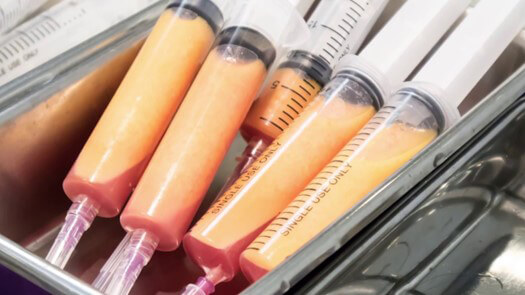 Recently, autologous fat is increasingly being used to restore the volume and shape of the breast. The technique is referred to in the literature as hybrid breast augmentation and allows the use of implants of smaller volume, mainly anatomical, to give a natural look. Whatever volume is still lacking to reach the final goal is provided by using fat in the superficial layers under the skin. In this way the edges of the implant are also perfectly concealed, especially in difficult cases with thin skin on the chest.
This fat is harvested, using the classic liposuction technique, from the abdomen or buttocks and, after appropriate processing, placed in the breast
If there is also mild to moderate nipple ptosis, we usually offer the option of the signature smart breast technique to avoid the vertical incision, where feasible. If the ptosis is significant, we propose simultaneous mastopexy and augmentation. In rare cases of massive weight loss, a two-stage operation is required.
Some women do not want an implant at all in their breast augmentation, so we use fat exclusively. A limitation of the technique is the final volume of the reshaped breast, which often also leads to a second operation. The final aesthetic result is very natural and contains no foreign bodies, but requires specialised mammographic monitoring postoperatively.
Much has been said recently about the possibility of breast cancer developing from the use of implants. The literature reports very few cases, involving a specific type of lymphoma (anaplastic large cell lymphoma of the capsule – ALCL) that developed in the implant capsule of a small number of women worldwide. The probability of developing this type of cancer can be compared to the probability of being struck by lightning (negligible). It is diagnosed with breast MRI and treated with capsulectomy and removal of the implants.
Also, because of the uproar caused by the use of implants based on industrial rather than medical-grade silicone, our recommendation to women interested in breast augmentation is not to think about the additional cost and to use implants with a lifetime warranty. It is important that, after the operation, the woman is provided with the special card that certifies the type and size of the implant used and protects her for all the following postoperative years. Of course, a lifetime warranty does not mean that an implant will be able to maintain its characteristics for a human lifetime. Our experience has shown that after the first 15 years, MRI of the implants with special views checking their integrity is advisable.
Over the last 5 years, three new types of implants have appeared:
– The first concerns the outer surface of the implant, for which nano-textured silicone is not used, but polyurethane. This gives the implant 'velcro' properties, particularly desirable in cases with moderate nipple ptosis, since they hold it more easily in a higher position. However, we must stress that if a replacement is desired, partial removal of the capsule is required, a more extensive operation that thins the breast.
– The second concerns the material of the implant itself. Using micro-bead technology similar to memory foam mattresses, an implant up to 30% lighter than the usual one has been made. They are preferred mainly for larger implants or for female athletes.
– The third type concerns their ergonomics and is of interest mainly to women who want a softer feel in their breasts that follows their movements.
As regards techniques of subfascial implant placement (subfascial breast augmentation), our view is that they are suitable for specific cases with sufficient coverage on the chest, since the muscle fascia is usually too thin to deliver the required result. The use of special biocompatible meshes (which have been used for years in breast reconstruction) is indicated in these cases, increasing the final cost of the operation exponentially.
Finally, there is also a very small group of women who, although they show no capsular contracture or pronounced clinical symptoms, complain of discomfort some years after an entirely successful implant placement. In the literature it is referred to as implant illness and the causes of the phenomenon have not been fully clarified. It is evident, however, that after removal of the implants the majority of women experience great relief.
During the visit to the office, the available options that match the patient's wishes, the details of the operation, the type of anaesthesia proposed for the specific case, any complications and the likelihood of their occurrence and, finally, the cost of breast augmentation with placement of a specific implant will be analysed in detail.