




RHYTIDECTOMY – FACELIFT – FACE LIFTING
 The time machine!
How many times have we caught ourselves in the mirror lifting the jawline and cheekbones to where they were a few years ago? Most of us wish to return to that image, but few decide to do it. This is because rhytidectomy is the most technically demanding facial operation in plastic surgery. It does, however, immediately deliver excellent aesthetic results. The techniques have changed considerably over the last 50 years, with the aim of achieving a more natural result, greater durability over time, a shorter postoperative absence from work and fewer complications.
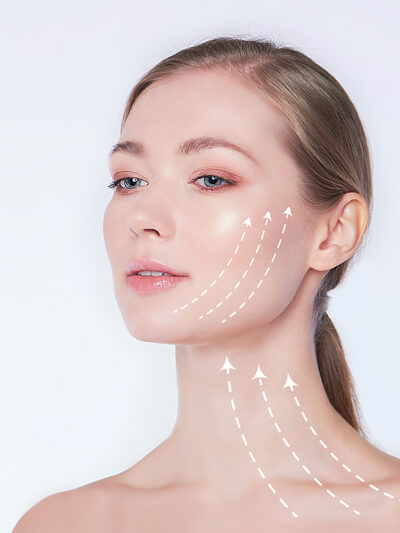
Depending on the extent of the operation, rhytidectomy is performed either under local anaesthesia, or in combination with sedation, or under general anaesthesia. Its main purpose is not only to treat the wrinkles on the face, but also the cause behind them, i.e. the laxity of the deeper tissues of the face.
All attempts at simply removing excess skin have not stood the test of time and have a poor aesthetic result that lasts very little. Therefore, to achieve a long-lasting result, we must somehow suspend the deeper tissues of the face back to their previous position.
This can be done either with the use of special sutures (MACS facelift), or by plicating the fascia that covers all the mimetic muscles of the face (SMAS plication), or by dissecting this fascia (deep plane facelift) and fixing it at points of stable and permanent suspension (preauricular, to Loré's fascia, retroauricular, etc.)
Through an incision at the sideburn, in front of the tragus of the ear and/or behind the ear up to the hairline if the operation also involves the neck, we can suspend via the SMAS even the middle third of the face, through a technique established by the American plastic surgeon Sherrell Aston, FAME lifting. It took its name from the initials Finger Assisted Malar fat pad Elevation, which means suspension of the cheek fat pad through a simple movement with the index finger, which does not endanger the underlying branches of the facial nerve. The whole rationale is that the skin removed with rhytidectomy is stretched outwards, while all the other deep tissues are suspended vertically. In this way, the deformity that used to appear postoperatively in the past, giving the appearance of a face hit by a strong wind, is avoided. This suspension rearranges the tissues of the face and usually creates excess skin on the lower eyelid, so we consider it advisable for rhytidectomy to be combined with a lower blepharoplasty, either simple (pinch blepharoplasty), or more complex, which will also correct the bags under the eyes.
As the main method of facial rejuvenation, rhytidectomy combines excellently with many smaller techniques, to avoid the well-known "pulled look". Thus, with the use of autologous fat we recreate the three-dimensionality of the face, with a silicone chin implant we correct microgenia and the contour, and with lovelip lift the symmetry of the face and mouth.
In faces with a pronounced problem in the nasolabial folds and marionette lines, it combines excellently with the technique of endolift locally, providing a solution to the lack of collagen under the skin in the central face. Any skin changes (fine superficial wrinkles, discolouration, etc.) are treated at the same time with the use of chemical peeling.
A special category of rhytidectomy is the feminization technique, i.e. feminisation of the features of male faces. It is feasible with the use of special osteotomy tools capable of giving a smoother transition to characteristic bony prominences such as the forehead, the eyebrows, the sides of the eyes or the chin.
Many wonder whether it is advisable to start with a neck lift, or a facial rhytidectomy, or a combination of the two. We cannot answer this question because each case is individualised. Laxity is greater in some faces, while in others laxity of the neck has progressed significantly, leaving the face unaffected. Therefore every case is different, and a careful joint assessment will determine the appropriate treatment plan.
Much has been said about the duration of the result in the various facelift techniques. A very large role in this is played by the age at which it is performed, the technique we follow, fluctuations in weight and lifestyle. What is certain is that a face, even many years after a rhytidectomy, will never return to the same condition it was in before it.