




MICROLIFT
The evolution of the Mini Facelift
A youthful face, with effortless naturalness!
The moment has come when laxity in the face has discreetly made its appearance: botox no longer seems to be enough, hyaluronic acid requires large quantities to offer tangible results and the other non-invasive (or minimally invasive) treatments have a short duration. Time, then, to relax and make decisions!
The first solution that comes to mind for treating the deepening of the nasolabial fold, the festoons that appear as double "bags" in the middle of the face, and the descent of the eyebrow and cheekbones is surgery. In practice, a complete surgical treatment requires extensive incisions, a long recovery time (over 15 days) and a lot of patience. In an attempt to reduce all of the above, the mini–facelift solution appeared. Although they offer mini recovery time and mini incisions, unfortunately they are accompanied by a mini aesthetic result: a mild feeling of looking "rested" without lasting effect, as they rely mainly on the skin's ability to maintain the suspension that the face requires.
The right solution should offer the strength and durability of the High SMAS technique (with suspension and/or plication of the SMAS, the fascia covering the muscular system of the face), the midface suspension capability of FAME (Finger Assisted Malar fat pad Elevation), the short recovery time of MADE (Minimal Access Deep plane Extended) and incisions smaller than those of MACS (Minimal Access Cranial Suspension).
With these characteristics, the evolution of the mini–facelift was born: the Microlift.
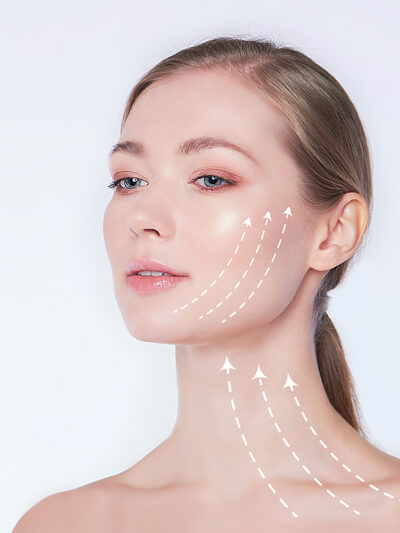
It took its name from one single, small incision carefully hidden in the hair-bearing skin of the temple down to the ear. It differs, however, from the temporal lift because it does not concern only the suspension of the eyebrows or the skin of the temple, but almost the entire face. It is performed with the help of local anaesthesia and/or sedation, depending on the extent of the problem. Through the incision, it is possible to dissect the SMAS and fix it at a higher point, and even fold it over itself when additional volume is required in the cheekbones. Just beneath the SMAS and the orbicularis muscle of the eyelids, it offers access to the fat of the cheek and the possibility of repositioning it in its original position. If the midface has descended significantly, the method is combined with dissection of the midface through a small incision inside the mouth before the final suspension (midface lift).
In cases where the smile line (ogee line) is indistinct due to excess fat low in the cheeks, it can be removed from inside the mouth (buccal fat pad reduction) through the same incision. In the scalp skin, the incisions are closed using a trichophytic technique, so that no alopecia (thinning) is created. Especially in men, changing the hairline is avoided, since the lift follows a vertical direction. The result of the above is a face without signs of laxity, with naturalness in movement and expressions and a youthfulness that does not betray surgical correction.
Although the operation has an average duration of 2 hours, it gives an aesthetic result that rivals much larger facelifts (8-10 years). Due to the limited undermining, the recovery time does not exceed one week, so a return to work is possible. No stay in the clinic is required after the microlift. In the first days mild swelling appears, mainly in the temple and the lower eyelid, which gradually subsides by the 3rd-5th day. Strenuous activities (gym, etc.) should preferably be avoided for the first 2-3 weeks. The final result is complete in 1 month.
Apart from the usual contraindications of simple operations, the main contraindication for the microlift is laxity in the lower face and neck, which requires larger incisions for its correction. Of course, the operation can be modified to correct such problems, but it then loses the dynamic of minimal incisions that characterises it.
The microlift can be combined with many techniques that rejuvenate the area: micro fat grafting (to correct dark circles, sunken eyes and general loss of volume in the face), brow lift (with minimal upward extension of the incision in the temple), as well as with upper / lower blepharoplasty, making it a valuable "multi-tool" in the right hands.
The evolution of the mini–facelift, the microlift, is the ideal solution for women and men of -as a rule- middle age who want to treat laxity with the smallest possible incision and a flawless aesthetic result, without compromising on duration.