




HYALURONIC ACID
Replenishing the skin's lost volume
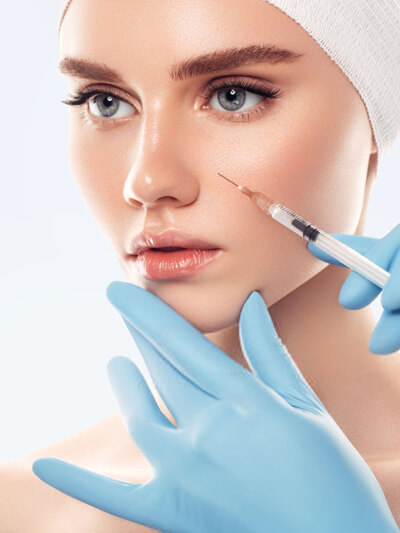
Unlike Botox which acts only on expression lines and before they are fully established, the various fillers (injectable implants) aim to replenish all the lost volume beneath static wrinkles and natural folds. Their main representative is hyaluronic acid, a hydrophilic macromolecule in the form of branched chains, which is naturally present in the skin. It does not cause a foreign-body reaction when applied, nor allergic or other reactions. It is available in various forms, according to the depth in the face for which it is intended. Usually, with the use of anaesthetic cream or cold compresses, the application is completely tolerable.
Hyaluronic acid-based injectable implants are an excellent solution for the vertical lines between the eyebrows, the nasolabial folds and the "marionette" lines at the corners of the mouth, and effectively treat volume loss in the periorbital area (upper and lower eyelid). There in particular they require great experience in application, since any -mistakenly- superficial application is not aesthetically forgiving (creation of translucent purple-coloured spots based on the Tyndall effect).
They can also be used to conceal the imperfections of a rhinoplasty or to "camouflage" a nasal hump, making surgery unnecessary.
In the lip area the results are impressive: improved contour, increased volume and reduced wrinkles on the lips can be achieved painlessly, respecting the aesthetic rule of thirds (in the ideal smile the upper lip occupies one third, while the lower lip occupies two thirds).
Its contribution to the correction of atrophic acne scars is significant, after appropriate subcision and in combination with other correction methods (laser, dermabrasion, peeling, etc.)
To maintain a satisfactory result, the placement of hyaluronic acid must be repeated approximately every year, since the macromolecule is broken down by the body's enzyme hyaluronidase. This enzyme also exists in pharmaceutical form, making the procedure reversible.
Rational use is the golden rule. In the attempt to treat even the tiniest wrinkle, we are often asked for excesses, which should be avoided after appropriate discussion with the person concerned, while we also counter-propose alternative ways of treating the problem.